

You're usually not thinking about crow's feet in the mirror at rest. You notice them in a candid photo, on a video call, or mid-laugh when the outer corners of the eyes crease more than you expected. That's the moment many people start searching for a treatment and run into a wall of product names that don't answer the question.
The decision usually isn't just “Dysport or something else?” It's whether your lines are mostly from movement, how fast you want a result, how often you're willing to maintain it, and whether your injector understands your smile pattern well enough to soften the lines without flattening your expression. That's the lens I use when talking with patients in Easton about Dysport for crow's feet.
Table of Contents
- Why Patients Choose Dysport for Crow's Feet
- How Dysport Works Around the Eyes
- Who Is a Good Candidate for Treatment
- What Happens During and After the Appointment
- Dysport Compared to Botox, Daxxify, and Fillers
- Understanding the Cost and Treatment Frequency
- Choosing the Right Provider in Easton
- Aftercare, Side Effects, and When to Schedule Again
Why Patients Choose Dysport for Crow's Feet
A common consultation starts the same way. Someone smiles, sees the lines gather at the outer corners of the eyes, and says they still want to look like themselves in photos. They are not choosing a brand in that moment. They are choosing how much movement to keep, how often they are willing to come back, and how precise the treatment needs to be for their smile pattern.
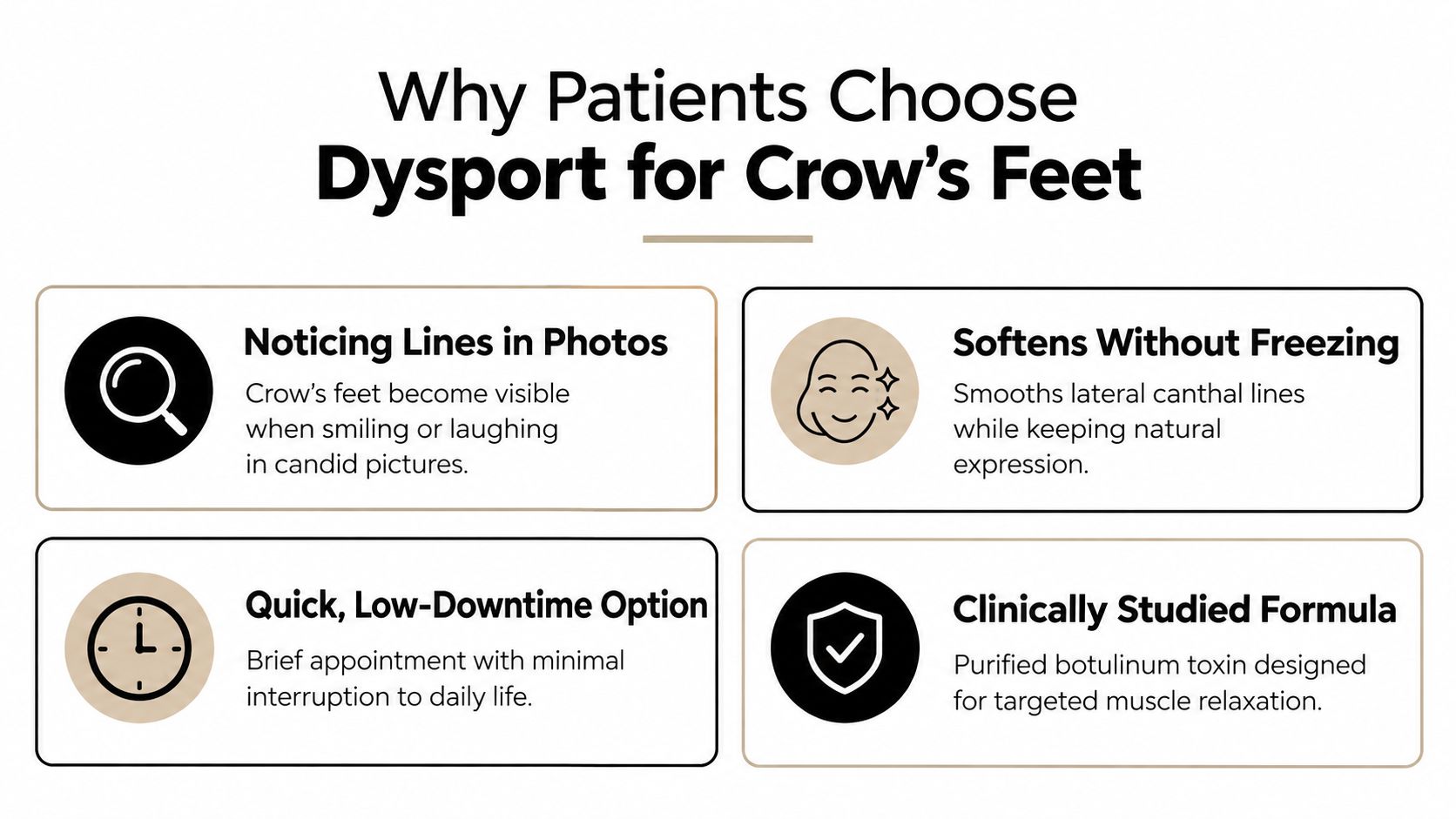
Dysport has been used in aesthetics for years, and abobotulinumtoxinA received FDA approval for cosmetic use on April 29, 2009 according to the FDA approval documentation. In practice, the appeal around crow's feet is less about the label and more about how the treatment behaves in a broad, active area beside the eyes. Patients with wider lateral lines or a strong full-cheek smile often do well when the injector can treat that area evenly and keep the result from looking patchy.
That is why I frame this as a procedural choice.
For crow's feet, the result is shaped by three things more than the product name. First is the way the eye area moves when you smile, squint, or laugh. Second is your retreatment rhythm. Some patients are comfortable returning on a set schedule, while others want a plan that fits around busy seasons, travel, or major events. Third is injector judgment. A good plan softens the pull that creates the lines without over-treating the lower eyelid or changing the character of the smile.
Why this area responds well
The outer eye is usually a straightforward treatment area because the target pattern is visible during expression. That makes it easier to tailor the injection points to the actual wrinkle fan instead of treating from a generic template.
There are trade-offs. A broader treatment pattern can create a smoother result across the lateral eye, but too much spread or poor placement can affect nearby movement and make the smile look less natural. A lighter approach preserves more animation, but some lines will still show when you grin hard. Many patients prefer that balance once they understand it.
Practical rule: The best crow's-feet treatment plan follows your smile pattern and maintenance preference. The vial matters less than the mapping.
What patients are usually trying to preserve
Many people asking about Dysport for crow's feet want a few specific things:
- Softer lines at the outer eyes without a frozen look
- An appointment that fits into a normal day with little interruption
- A maintenance schedule they can realistically keep
- A result that still looks like them in conversation and in photos
That is why patients choose Dysport for this area. They are usually choosing a treatment style, a dosing approach, and a follow-up rhythm that fits their face and routine. Done well, it looks less like "having something done" and more like looking less creased when you smile.
How Dysport Works Around the Eyes
Crow's feet come from repeated contraction of the orbicularis oculi, the circular muscle that wraps around the eye. The outer portion of that muscle pulls the skin into the radiating lines you see when you smile, squint, or laugh. If those muscle contractions are strong, the lines look deeper and spread farther laterally.

Dysport is a botulinum toxin type A treatment. It works by blocking the release of acetylcholine at the neuromuscular junction, which reduces how strongly the treated muscle can contract. The easiest way to think about it is not as turning facial movement off, but as turning the dimmer down. A good treatment doesn't unplug the lamp. It reduces the intensity.
What changes in the mirror
When the orbicularis oculi contracts less forcefully, the skin beside the eye doesn't bunch as hard during expression. That leads to smoother animation and often a more rested look in photos. It won't change skin texture the way a resurfacing treatment would, and it won't fill in etched lines the way a filler might. Its job is narrower and cleaner than that. It reduces the motion that creates the wrinkle.
A clinical review of lateral canthal line treatment reports typical crow's-feet dosing ranges of 4 to 16 units per side, with 2 to 4 units per injection point and 3 to 4 injection points per side, which is useful because it shows how the treatment is usually distributed rather than placed in one spot alone, as outlined in this clinical review of lateral canthal dosing mechanics.
Why placement matters more than patients realize
Crow's feet are close to structures you don't want to weaken by accident. If injections drift too low or too far into nearby smile muscles, the result can look off even if the product itself is good. That's why I look at how someone smiles at full expression, not just how the area looks at rest.
A split-face study in 40 patients found no statistically significant difference in crow's-feet outcomes between one 36-unit injection and three 12-unit intradermal injections when the total dose was the same, and adverse events were equivalent, according to this PubMed-indexed split-face trial. The practical takeaway is simple. For this area, total dose and precise placement may matter more than the number of injection points.
The product can only do what the plan allows. If the smile pattern isn't mapped first, the treatment becomes guesswork.
Who Is a Good Candidate for Treatment
The best candidates for Dysport for crow's feet are adults with dynamic lateral canthal lines, meaning lines that show most clearly with smiling, squinting, or laughing. They're usually looking for softening, not total erasure. That expectation matters.
Some people should wait, and some shouldn't be treated until they've had a proper medical review. Pregnancy, breastfeeding, an active skin infection near the injection area, certain neuromuscular disorders, or a known allergy to botulinum toxin products or their components all change the conversation.
Candidacy at a Glance
| Ideal Candidates | Postpone or Avoid |
|---|---|
| Adults bothered by lines that deepen with expression | Anyone who is pregnant or breastfeeding |
| Patients in good general health with realistic goals | Patients with active infection or irritation at the injection site |
| People who still want natural movement | Patients with certain neuromuscular disorders such as myasthenia gravis or ALS |
| Those willing to maintain treatment periodically | Anyone with a known allergy to botulinum toxin or formulation components |
What gets reviewed before treatment
Medication and supplement history matters more than many patients expect. Blood-thinning medications and supplements can increase bruising risk. Certain muscle relaxants or aminoglycoside antibiotics can also affect how neuromodulator treatment behaves.
This is one reason a real consultation should feel medical, not sales-driven. A good injector doesn't just decide whether you want treatment. They decide whether treatment makes sense for you, right now, with your anatomy and your health history.
What Happens During and After the Appointment
The appointment starts before the syringe comes out. The first step is facial mapping. I want to see the area in motion, so patients are asked to smile, squint, and fully relax. That shows where the orbicularis oculi is strongest, whether one side pulls harder than the other, and whether the pattern reaches farther down into the cheek than expected.

The skin is then cleaned. Makeup is removed if needed, an antiseptic is used, and some patients prefer ice or topical numbing first. This area is tolerated well because the injections are quick and shallow.
Typical treatment pattern
In everyday practice, a common starting approach for crow's feet is about 10 to 15 units per side placed over roughly 3 to 5 lateral injection points, adjusted for muscle strength and the width of the smile pattern. The feel is usually a brief sting or pinch rather than ongoing pain, and chair time is commonly about 10 to 15 minutes.
Published evidence supports a range rather than one rigid formula. A multicenter randomized trial reported that 15, 30, and 45 units of Dysport were effective and safe for mild to severe crow's-feet lines, and a related comparative study found 65% of patients still rated as improved at 4 months versus 47% in the comparator group, as reported in this study abstract on crow's-feet dosing and persistence.
What the first two weeks usually look like
Most patients don't walk out looking different beyond mild treatment-site changes. Small bumps and a bit of redness can happen right away and usually settle quickly.
A practical timeline looks like this:
- Day 1: Mild redness or tiny raised spots at the injection points can show up, then fade.
- Days 2 to 3: Early softening may start during animation.
- Days 5 to 7: Many patients notice clearer smoothing.
- Days 10 to 14: The full effect is usually visible.
After treatment, stay upright for four hours, don't rub the area, and skip strenuous exercise until the next day. Those instructions aren't arbitrary. They're meant to reduce the chance of unintended spread while the product is settling into the planned muscles.
If a patient has an event coming up, timing matters more than brand loyalty. A treatment done too late is more disappointing than a good treatment done on the right schedule.
Dysport Compared to Botox, Daxxify, and Fillers
Crow's feet patients usually hear four categories in consultation. A wrinkle relaxer with broader spread, a wrinkle relaxer with a more contained feel, a newer long-duration wrinkle relaxer, and filler for lines that remain even when the face is still. Each solves a different problem.
Crow's Feet Treatment Options at a Glance
| Treatment | Mechanism | Onset | Duration | Best For |
|---|---|---|---|---|
| Dysport | Relaxes the muscle that creates dynamic crow's feet | Often valued when patients want an earlier visible change | Commonly about 3 to 4 months | Broad lateral canthal movement patterns |
| Botox | Relaxes the muscle that creates dynamic crow's feet | Established option for controlled softening | Varies by patient and plan | Patients who prefer a more contained treatment feel |
| Daxxify | Relaxes the muscle with a peptide-stabilized formulation | Varies by patient | May appeal to patients seeking longer spacing between visits | Patients prioritizing fewer appointments |
| Filler | Adds support to etched or static lines rather than reducing motion | Immediate structural effect | Depends on product and placement | Static creasing that remains at rest, often as a complement |
For Botox labeling specifically, the FDA-approved crow's-feet protocol is 4 Units in 0.1 mL into each of 3 sites per side, for 12 Units per side and 24 Units total when both sides are treated, with a total volume of 0.6 mL, according to the FDA-approved BOTOX Cosmetic label. That's useful as a contrast because Dysport is commonly used in distinct unit ranges rather than a one-to-one unit match.
A systematic review and consensus review noted that Dysport has been studied specifically for lateral canthal lines, with treatment effects observed through a 24-week study period and benefit still detectable up to Week 16 in the canthal region. The same review reported a median total dose of 50 units for both sides for lateral canthal lines, and one clinical report found a 94% response rate at Month 1 in a study population, as summarized in this NCBI review on botulinum toxin use for lateral canthal lines.
If you're comparing longevity-focused options, it helps to review how different neuromodulators fit your maintenance style. Patients who want to learn how another option is positioned in Easton can review Daxxify treatment information in Easton, MD.
What doesn't work well
What usually disappoints patients is using filler for a movement problem alone, or using neuromodulator alone when the line is etched at rest and clearly structural. Mixed lines often need a layered plan. Purely dynamic lines usually don't.
Understanding the Cost and Treatment Frequency
Cost gets confusing because practices may quote by unit, by area, or as part of a membership structure. For crow's feet, the more useful question is not “What's the cheapest session?” It's “What rhythm gives me the result I want without overtreating or constantly chasing the effect back?”
In practice, Dysport for crow's feet is commonly priced by unit. The exact cost in Easton varies by provider, injector experience, and whether you're paying for an area-based package or unit-based dosing. A patient with strong smile muscles, wider lateral lines, or significant asymmetry may need a different plan than someone with lighter movement.
How to think about yearly value
Aesthetic reviews have reported a median duration of full response of 85 days after 50 Dysport Units for glabellar lines, and another study reported 109 days after 50 to 80 Dysport Units, supporting the idea that Dysport effects commonly last in the 3 to 4 month range in clinical trials, as summarized in this peer-reviewed practical dermatology review.
That doesn't mean every patient should book the moment movement starts returning. In fact, many do better when retreatment is planned thoughtfully around travel, events, photography, and how much motion they're comfortable having between visits. If you want a more detailed look at timing, how long Dysport lasts is worth reviewing before you schedule.
Cost only makes sense when paired with rhythm. A lower per-visit price can still be the wrong fit if the schedule doesn't match your goals.
The patients who feel happiest long term usually aren't the ones hunting for the lowest entry price. They're the ones who understand what result they want to maintain and how often they're willing to come in to maintain it.
Choosing the Right Provider in Easton
Crow's feet are close to the eye, close to smile muscles, and easy to undertreat or overtreat if the injector uses a generic map instead of your actual facial movement. That's why provider selection matters more here than it does in many patients' first online searches.
A strong consultation should answer a few direct questions. Who is injecting? How often do they treat lateral canthal lines? Do they watch you smile at full expression before marking the face? What's the plan if one side is stronger, or if you're intentionally trying to keep more movement?
What a careful injector looks for
An experienced injector watches for more than wrinkles. They look for baseline asymmetry, brow position, cheek support, and whether your smile recruits nearby muscles that could be affected if placement drifts. That's how you reduce the risk of an unnatural smile, heaviness, or an imbalanced result.
A more recent randomized clinical trial found that both botulinum toxin A products improved dynamic lateral canthal rhytides by week 2, but the benefit diminished over time and was no longer different from baseline by week 16, with similar satisfaction through follow-up, according to this 2025 randomized clinical trial abstract. That's a useful reminder that “best” is often less important than when you want the result and how you plan maintenance.
Why physician-led matters
Physician-owned and operated practices tend to approach this area with more medical discipline because the consultation doesn't stop at the wrinkle. It includes contraindications, facial dynamics, and a plan for what to do if the result needs refinement. The Easton office also offers the Entity Med AI Simulator, which can help patients preview possible softening patterns before treatment so the conversation starts with realistic expectations instead of guesswork.
For patients comparing options locally, Dysport treatment in Easton, MD is one route to review if you want a physician-supervised setting, a defined consultation process, and an injector looking at your smile pattern rather than selling a one-size-fits-all area treatment.
Aftercare, Side Effects, and When to Schedule Again
The first day after treatment is usually uneventful if patients follow simple instructions. Stay upright for four hours, avoid rubbing or pressing the outer eye area, and skip intense workouts until the next day. I also prefer that patients delay facials, saunas, and anything that puts pressure or excess heat on the area right away.

Bruising risk is also worth managing. If your prescribing clinician says it's medically safe, many patients are advised to avoid nonessential blood-thinning supplements or medications that can increase bruising around treatment time. This is individualized, so it should be reviewed rather than assumed.
What's normal and what deserves a call
Expected short-term effects are usually mild. Small bumps, light redness, or a pinpoint bruise can happen and often settle quickly.
Independent reviews and clinical studies on crow's feet generally report botulinum toxin A effects lasting about 3 to 4 months, with common adverse effects being mild and transient, while less frequent issues can include eyelid ptosis, brow ptosis, and facial asymmetry, as discussed in this medRxiv review manuscript on crow's-feet treatment considerations.
Call your injector if you notice:
- A heavy eyelid that wasn't present before treatment
- An asymmetric smile that appears new after injections
- Double vision or unusual visual symptoms
- A rash or concerning reaction beyond mild localized irritation
When to come back
The earliest sign that treatment is wearing off is usually the return of micro-movement at the outer eye during smiling. Many patients notice that before they see full wrinkle return. That's useful because it helps time the next visit before the area feels like it completely reset.
A comparative study indexed in PubMed found that at 4 months, 65% of patients treated with abobotulinumtoxinA still showed effect in the crow's-feet area versus 47% for onabotulinumtoxinA, according to this PubMed-indexed head-to-head study. Even so, the right retreatment point is personal. Some patients want consistent smoothing and little return of motion. Others prefer more spacing and accept more visible animation between visits.
Settling into a rhythm of several treatments per year rather than trying to force a fixed calendar date keeps the plan responsive to your face, not just the clock.
If you're considering Dysport for crow's feet, ProMD Health Easton offers physician-owned and operated aesthetic care with consultation-based planning, smile-pattern assessment, and neuromodulator treatment that's suited to how your eye area moves. Patients across Easton and the Eastern Shore who want a natural result can explore options and request a visit through ProMD Health Easton.