

What Is the MT 2 Peptide — and Why Is Everyone Talking About It?
The mt 2 peptide (also written as Melanotan II or MT-II) is a synthetic analog of alpha-melanocyte-stimulating hormone (α-MSH) — a naturally occurring hormone that controls skin pigmentation, appetite, and sexual function.
Here’s a quick snapshot of what it does:
- Tanning — Stimulates melanin production for deeper skin pigmentation, even with minimal sun exposure
- Appetite suppression — Activates brain receptors linked to reduced food intake and weight management
- Sexual function — Enhances libido and erectile response in both men and women
- Immune modulation — May influence inflammation and immune system activity
Important: MT-2 is not approved by the FDA, MHRA, TGA, or any other major regulatory agency for human use. It is classified as an unlicensed research chemical in most countries.
MT-2 was originally developed at the University of Arizona in the 1980s as a potential sunless tanning agent — researchers hoped it could reduce skin cancer risk by promoting pigmentation without UV exposure. It later gained notoriety as the so-called “Barbie drug” due to its dramatic tanning effects and widespread unsupervised use online.
What makes it unusual is the breadth of its effects. Unlike most compounds that do one thing, MT-2 acts on multiple melanocortin receptors throughout the body — producing tanning, appetite changes, and sexual arousal simultaneously. That’s not a side effect list. That’s the mechanism.
I’m Brian R. Baker, M.D., Medical Director of ProMD Health Easton, and my background in emergency medicine, hormone optimization, and aesthetic wellness gives me a grounded perspective on peptides like the mt 2 peptide. In this guide, I’ll walk you through what the science actually says — clearly and honestly.
The Science of Melanocortins: How MT-2 Works
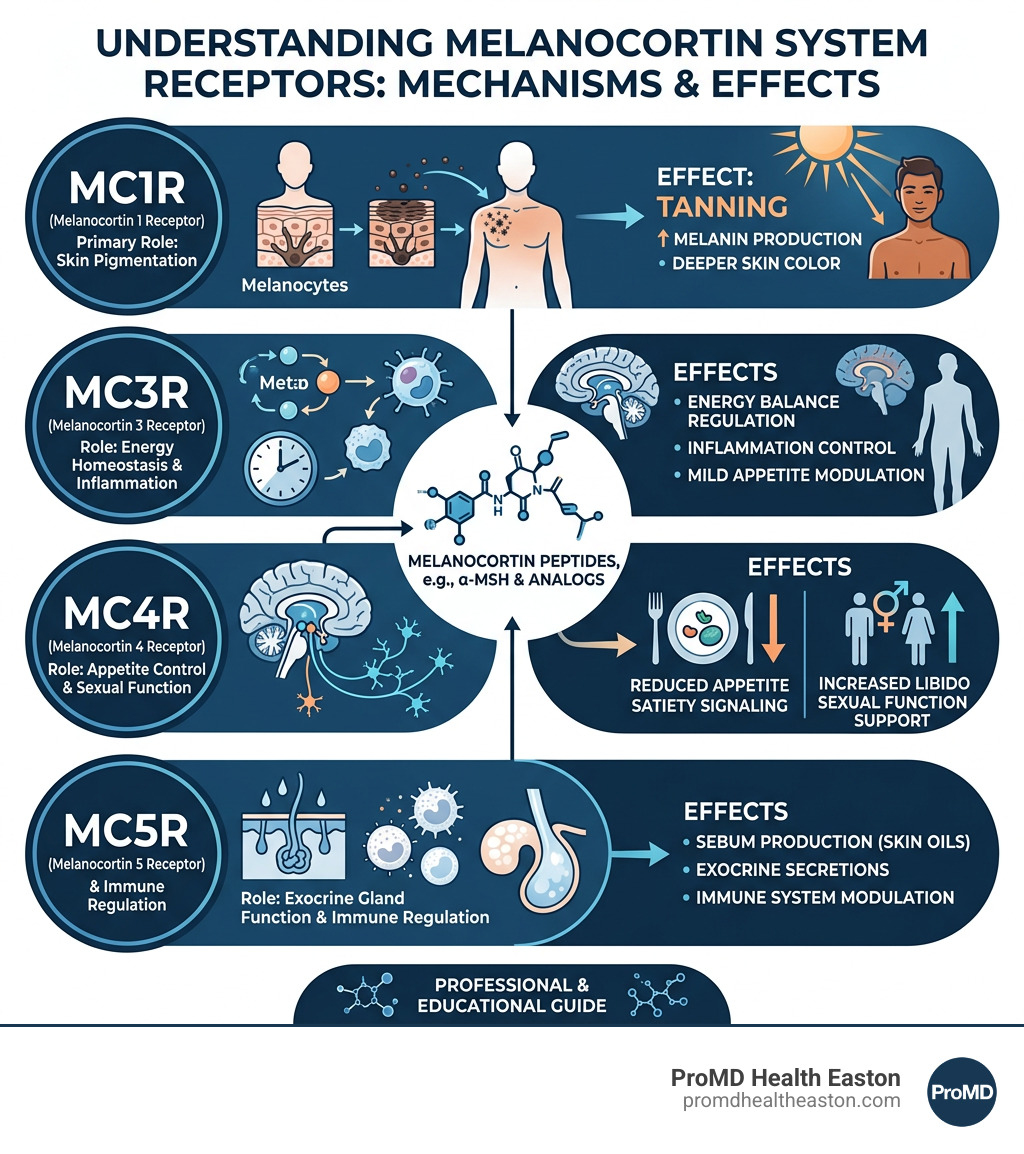
To understand the mt 2 peptide, we have to look at the “instruction manual” of the human body: the melanocortin system. This system consists of five different receptors (MC1R through MC5R) that act as docking stations for hormones. When a hormone “plugs in” to one of these receptors, it triggers a specific biological response.
Chemically, MT-2 is a cyclic heptapeptide with the CAS registry number 121062-08-6. Its structure features a unique “lactam bridge,” which essentially ties the peptide into a loop. This cyclic shape is crucial because it makes the molecule much more stable and resistant to being broken down by the body’s enzymes compared to natural α-MSH.
Unlike many modern drugs that are designed to be “selective” (targeting only one receptor), MT-2 is a non-selective agonist. It has a high binding affinity for almost all the melanocortin receptors. Scientists measure this affinity using Ki values — the lower the number, the more “sticky” the peptide is to that receptor:
- MC1R (Skin Pigmentation): 0.23 nM
- MC3R (Metabolism/Inflammation): 0.31 nM
- MC4R (Appetite/Sexual Function): 0.19 nM
- MC5R (Exocrine Gland Function): 0.72 nM
Because it binds so strongly to MC4R (0.19 nM), it has profound effects on the central nervous system, which explains why it impacts arousal and hunger so significantly. You can find deeper technical data on its molecular structure at ChEMBL430239.
Distinguishing MT-2 from Melanotan I
It is very common for people to confuse mt 2 peptide with its older sibling, Melanotan I (also known as Afamelanotide). While they share a similar name and origin, they are very different tools.
Melanotan I is a linear peptide that is much more selective for the MC1R receptor. Because it doesn’t cross the blood-brain barrier as effectively as MT-2, it primarily causes tanning without the intense systemic side effects like nausea or sexual arousal.
In fact, Scientific research on Afamelanotide led to its FDA approval (under the brand name Scenesse) for treating phototoxicity in patients with erythropoietic protoporphyria (EPP).
MT-2, however, remains unapproved. Its “systemic” nature means that while you might get a tan, you are also activating receptors in the brain and other organs, which carries a much higher risk profile.
| Feature | Melanotan I (Afamelanotide) | Melanotan II (MT-2) |
|---|---|---|
| Structure | Linear | Cyclic (Lactam Bridge) |
| Selectivity | Primarily MC1R | Non-selective (MC1R, 3R, 4R, 5R) |
| FDA Status | Approved for EPP | Unlicensed / Research Only |
| Primary Effects | Tanning | Tanning, Libido, Weight Loss |
| Half-Life | ~30 minutes | ~33-40 minutes |
The Multifaceted Benefits of mt 2 peptide: Tanning and Beyond
At ProMD Health Easton, we often see patients interested in Peptide Therapy for various wellness goals. While we prioritize safety and approved protocols, it is important to understand why the mt 2 peptide has garnered such a massive following in the “biohacking” and fitness communities.
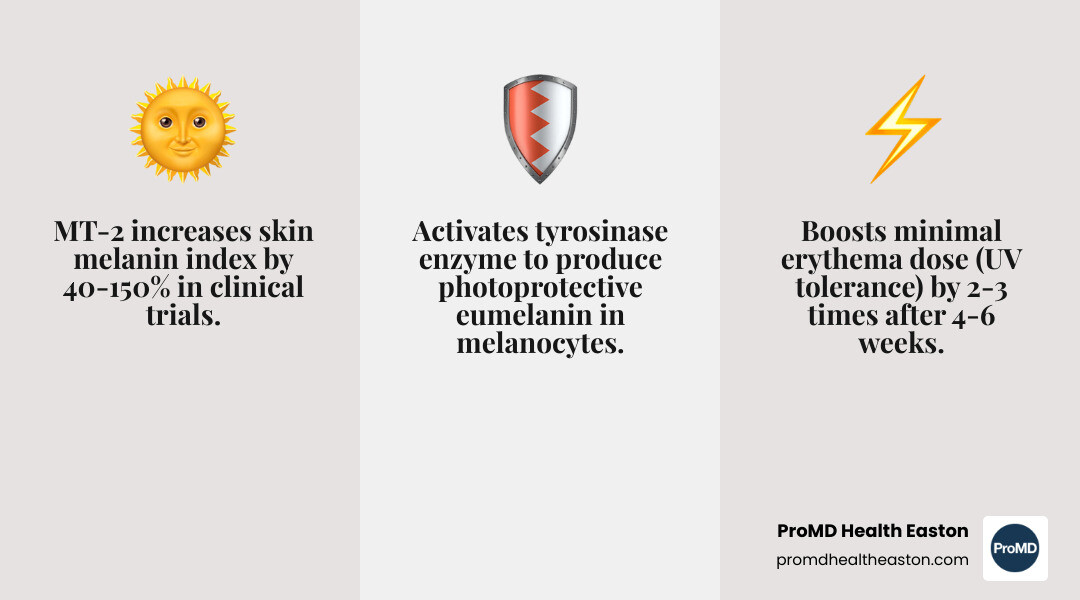
The primary draw is the “Melanin Index” increase. Clinical trials have shown that MT-2 can cause a 40% to 150% increase in skin melanin. This isn’t just a surface-level stain like a spray tan; it is a fundamental change in the skin’s chemistry.
How mt 2 peptide Stimulates Melanogenesis
Melanogenesis is the process by which melanocytes (specialized skin cells) produce melanin. Usually, this process is triggered by UV radiation from the sun, which acts as a “damage signal.” The mt 2 peptide bypasses the need for damage. It acts as a direct signal to the melanocytes, activating the enzyme tyrosinase.
Tyrosinase is the rate-limiting enzyme in melanin production. Once activated by MT-2, it begins churning out eumelanin — the dark, photoprotective pigment found in people who tan easily.
According to Research on tanning activity, even a few low doses can significantly darken the skin. One of the most interesting findings in early research was the increase in the “Minimal Erythema Dose” (MED). After 4 to 6 weeks of use, some subjects found their UV tolerance increased by 2 to 3 times. This suggested that MT-2 might offer a form of internal photoprotection, though it is absolutely not a replacement for traditional sunscreen.
mt 2 peptide for Metabolic and Sexual Health
The “waves” this peptide is making aren’t just at the beach. Because it targets the MC4R receptor in the hypothalamus, MT-2 has two major “off-label” effects that have intrigued researchers for decades.
1. Appetite and Weight Management In preclinical models, MT-2 has demonstrated a powerful anorectic (appetite-suppressing) effect. Studies on diet-induced obese (DIO) rats showed a 30-50% reduction in food intake, leading to a 15-25% loss in body weight over just four weeks. This has led some to investigate its potential alongside modern Weight Loss Injections, although human data for this specific use remains sparse and unregulated.
2. Sexual Function and Libido Perhaps the most famous “side effect” of MT-2 is its impact on sexual arousal. During early tanning trials, male volunteers reported spontaneous and prolonged erections. This wasn’t a vascular effect like Viagra; it was a central nervous system effect.
A Clinical study on psychogenic ED found that 60-80% of men with psychogenic erectile dysfunction reported adequate erections after a dose of 0.025 mg/kg, compared to only 20-30% in the placebo group. This discovery eventually led to the development of PT-141 (Bremelanotide), an FDA-approved treatment for female sexual arousal disorder.
Administration, Dosing, and Purity Verification
If you are researching the mt 2 peptide, you will likely find a confusing array of “loading” and “maintenance” protocols. In a clinical research setting, MT-2 is almost exclusively administered via subcutaneous injection (into the fatty tissue, usually around the abdomen).
Typical research doses hover around 0.025 mg/kg per day. For an average adult, this is a very small amount, often measured in micrograms (mcg). The peptide has high bioavailability (80-90%) when injected, with a peak concentration (Tmax) occurring about 1 to 2 hours after the shot.
At ProMD Health Easton, we emphasize that any form of hormonal or peptide intervention should be handled with extreme care. You can find More info about hormone services at our clinic to see how we manage regulated therapies.
Verifying Peptide Quality and Purity
One of the biggest risks of the mt 2 peptide isn’t the peptide itself — it’s the source. Because it is not a regulated medicine, the “gray market” is flooded with low-quality products.
If you are looking at a Guide to MT-2 purity, there are two gold-standard tests you should know about:
- HPLC (High-Performance Liquid Chromatography): This determines the purity. A reputable research source should show a purity of >95%.
- Mass Spectrometry (MS): This confirms the “fingerprint” of the molecule, ensuring it is actually MT-2 and not a cheaper substitute.
The Risks of Unregulated Sources:
- Contaminants: Heavy metals, bacteria, or leftover solvents from the manufacturing process.
- TFA Residues: Trifluoroacetic acid is often used in peptide synthesis; if not properly removed, it can be toxic to cells.
- Mislabeled Dosing: A vial labeled 10mg might actually contain 5mg or 15mg, making accurate dosing impossible.
For stability, lyophilized (freeze-dried) MT-2 should be stored at -20°C. Once reconstituted with bacteriostatic water, it must be kept in the refrigerator and used within a few weeks to prevent degradation.
Safety Profile and Regulatory Warnings
We would be remiss if we didn’t highlight the serious stance taken by global health authorities. The mt 2 peptide is currently the subject of numerous warnings.
- FDA Warning: The U.S. Food and Drug Administration has issued multiple warning letters to companies selling Melanotan products, citing them as unapproved new drugs and expressing concern over their safety.
- MHRA Safety Notice: The UK regulator has warned that “tan jabs” are unlicensed and potentially dangerous.
- TGA Regulations: In Australia, the Therapeutic Goods Administration has banned the sale and advertisement of MT-2 for human use.
In Ireland, the HPRA reported a massive surge in illegal listings, removing over 500 social media and e-commerce ads for the peptide in a single year. These agencies aren’t just being “party poopers” — they are responding to real-world reports of harm.
Short-Term and Long-Term Health Risks
The immediate side effects of the mt 2 peptide are very common. In clinical trials, 60-80% of participants experienced nausea, especially at higher doses (≥0.16 mg/kg). Other acute effects include:
- Facial Flushing: A sudden redness and warmth in the face.
- The Yawning/Stretching Complex: An odd, involuntary urge to yawn and stretch, often accompanied by arousal.
- Somnolence: Feeling unusually tired or sleepy.
The Long-Term “Unknowns” The most significant concern for dermatologists is the effect on moles and freckles. MT-2 can cause existing moles to darken rapidly and may trigger the appearance of “eruptive nevi” (new moles).
There is a heated debate in the medical community regarding melanoma. A Systemic review of melanoma risks noted that while there are case reports of users developing melanoma, it is difficult to prove the peptide caused it. Many users also engage in heavy UV exposure (sunbeds), which is a known carcinogen. However, the theoretical risk of stimulating melanocytes in a person with a genetic predisposition to skin cancer is very real.
Other rare but serious risks reported in literature include:
- Rhabdomyolysis: A life-threatening breakdown of muscle tissue.
- Priapism: A painful, persistent erection that requires emergency medical intervention.
- Posterior Reversible Encephalopathy Syndrome (PRES): A serious neurological condition involving brain swelling.
Frequently Asked Questions about MT-2
How long does it take to see results with MT-2?
Most researchers observe changes in skin tone within 5 to 10 doses. However, the “full” effect usually takes 3 to 4 weeks of consistent administration. The speed of the tan is heavily influenced by “UV synergy” — even a tiny amount of sun exposure can dramatically accelerate the darkening process when the peptide is active in the system.
Is MT-2 legal to purchase?
This is a legal gray area. In the United States, UK, and Australia, it is legal to buy MT-2 as a “research chemical” for laboratory use (not for human consumption). However, selling it for human use, or labeling it as a supplement/medicine, is illegal. At ProMD Health Easton, we strongly advise against purchasing “gray market” substances for self-administration.
Can the side effects like nausea be avoided?
In research settings, scientists often use “dose titration” to mitigate nausea. This involves starting with a “micro-dose” (e.g., 100mcg) and slowly increasing it over several days to allow the body to desensitize. Taking the dose right before bed or with a small meal is also a common tactic reported by users to sleep through the peak nausea period.
Conclusion
The mt 2 peptide is a fascinating example of how modern science can “hack” the body’s natural systems. From its origins as a potential skin cancer preventative to its current status as a controversial tanning and lifestyle aid, it remains one of the most powerful peptides ever synthesized.
However, at ProMD Health Easton, our philosophy is “Safety First.” Whether you are interested in Hormone Therapy for Men or Hormone Therapy for Women, we believe that every treatment should be medically supervised, backed by rigorous testing, and tailored to your unique biology.
If you are in Easton, MD, or the surrounding areas like Salisbury or Cambridge, we invite you to visit our clinic. We offer a state-of-the-art Entity Med AI Simulator that allows you to preview customized results for our approved aesthetic treatments, ensuring you have total confidence in your wellness journey.
Don’t leave your health to unregulated “research chemicals” found on the internet. Consult our experts in Easton today to explore safe, proven, and effective ways to look and feel your absolute best.